


Texas Homeowners Insurance Quotes
Everything You Need to Know About Home Insurance in Texas
Texas is known for its blend of rich history and modern innovation. From preserved sites like the Alamo to cities such as Bandera and Blanco that celebrate cowboy culture, the Lone Star State reflects its frontier roots. At the same time, major employers like NASA, Tesla, Dell Technologies, and USAA highlight Texas’s role as a hub for technology, finance, and industry.
As the largest contiguous U.S. state, Texas offers everything from big-city living in Dallas to coastal communities like South Padre Island and Corpus Christi, as well as quiet rural towns. However, homeowners across the state face varying risks, including flash floods, hurricanes, tornadoes, and wildfires, which can cause costly damage.
Protect your house from these events by talking to an expert agent at InsureOne, who can help you get the best homeowners insurance in Texas.
How Much Does Homeowners Insurance Cost in Texas?
Nationally, average rates for homeowners insurance are about $2,600. In Texas, the average is over $4,000. But these are just averages. Premiums can be well below or above these numbers depending on the cost of your home, the likelihood of natural disasters occurring in your area, fluctuations in construction costs, and various other factors. In fact, rates often vary from one zip code to the next, even within the same city, depending on local conditions.
Home insurance coverage in Texas is particularly costly because it is so disaster-prone. These natural disasters damage homes, and residents continue to file claims for reimbursement with their insurers, which drives up policy prices throughout the state. Supply chain disruptions and inflation in recent years have led to higher construction prices, which, in turn, have driven up premiums, as the repairs insurers must cover are more costly.
In some states, providers must get prior approval before increasing rates. Since Texas has a “file and use” system, where providers can inform regulators of an increase and charge higher premiums before getting an approval, rates can rise rather quickly, given some of the devastating natural disasters in the state, which cost insurers significant money.

How To Find Home Insurance in Texas
Many insurers are not so keen to sign up just any policyholder. In fact, many companies no longer operate in Texas because it is so disaster-prone. Even clients who have had policies for a while sometimes face difficulties renewing their policies if the roof, exterior, or walkways are not in top shape, now that insurers use drones to inspect properties.
The best way to ensure that a provider will want to insure your home is to be proactive. Maintain your house and property, so there are no apparent risks. If you live in a hurricane-prone city like Houston, make sure to get shutters for your windows, sump pumps for your basement, and impact-resistant roofing.
If you’re unable to obtain coverage through the standard market, you may need to explore state-backed options. In coastal areas, the Texas Windstorm Insurance Association (TWIA) provides wind and hail coverage for eligible homes, while other high-risk properties may require specialized solutions.
Regardless of where you live and the perils in your neighborhood, your InsureOne agent will work tirelessly to ensure you get a policy that meets your preferences.
How Do Home Insurance Deductibles Affect Rates in the Lone Star State?
There is a direct correlation between your premiums and your deductible, which is an amount you have to pay when you file a claim before your insurer starts covering the bill. Your provider will offer you better rates if you agree to a high deductible, since the insurer pays less when you file a claim. The opposite is true as well — lower deductibles will result in higher premiums because your insurer pays for more of the bill.
In Texas, there are different types of deductibles. For hurricanes and named storms, you would agree to a percentage of the damages, usually between 1% and 5%, that you would pay. So if you agree to a 3% named-storm deductible and Hurricane Imelda caused $10,000 of damage to your home in Galveston, your insurer would cover $7,000, and you would have to pay for the last $3,000 out of pocket.
For other issues, like wildfires or hailstorms, the deductible is a flat rate rather than being percentage-based. So if your home in Burnet suffered $6,000 in damage during the Williams Road fire and you have a $5,000 deductible, your insurer is only liable for $1,000.
Is Bundling Home and Auto Insurance in Texas a Good Idea?
There is an industry term for when you get more than one policy from the same carrier. It is called “bundling,” and it is one of the easiest ways to reduce premiums in a state where rates are higher than average. Insurers will offer a 5% to 25% discount if you bundle your homeowners and car insurance with them.
The reason why there is such a range in the discount percentage is that insurers do not just set a fixed amount since every scenario is different due to multiple factors. For example, homeowners insurance in Houston is costly because the city is hurricane-prone, so your insurer has more room to give you a larger discount. They are also more willing to offer a bigger break because there are many insurers vying for business in the big city. In contrast, property insurance in El Paso, which is rural, where rates are already lower, and there is not as much competition between insurers, the discount might not be as high.
State Bill 213 prohibits insurers from forcing policyholders to bundle car and home policies. However, your InsureOne agent will shop top-tier providers to offer you a customized package of policies with the best available prices. You will find that bundling saves you money and makes managing your bills and signing up for policies much simpler than having to obtain dwelling coverage in Texas through multiple insurers.
Comparing Home Insurance Rates by Coverage Levels in Texas
Although many other factors influence your rates, coverage level plays a heavy role. The following table shows the average cost of home insurance in Texas based on $100,000 in liability coverage, along with varying dwelling coverage amounts.
| Dwelling Coverage (Texas) | Average Annual Insurance Cost |
|---|---|
| $200,000 | $2,944 |
| $300,000 | $3,844 |
| $400,000 | $4,376 |
| $600,000 | $6,794 |
| $1,000,000 | $10,459 |
Is Home Insurance Tax Deductible in Texas?
Your homeowners policy is not tax-deductible if you live in your home and do not use it for commercial purposes. However, under the following conditions, you might be able to deduct part or all of your premiums on your tax return if you:
- Have a dedicated home office
- Rent part of or the entire house to tenants
- Rent part of or the entire house to a business
- Use your basement or garage for storage for work
If one or more of the above situations apply to you, you should discuss these details with your accountant to determine whether you can get a tax deduction and what amount.
Does Texas Have the 80% Homeowners Insurance Rule?
Insurers in this state follow the 80% rule, which is an industry standard that requires you to obtain property insurance in Texas for at least 80% of the amount it would cost you to replace your home if it is destroyed by a covered peril. If your home costs $400,000 to replace, you have to get $320,000 in replacement cost coverage, regardless of the market value of your home.
Local labor and material costs can fluctuate in Texas, so calculating replacement cost can get complicated, but your InsureOne agent will help determine the right amount of coverage to ensure you comply with the 80% rule.
What Factors Do Insurers Consider in Texas?
Insurers use many factors to determine a reasonable amount to charge you for your policy. Below are a few details that will influence your rates:
- Your location
- Construction materials used to build the house
- The age of your home
- The distance to the nearest fire hydrant
- Your credit score
- Your claims history
In Texas, insurers will also look at these factors due to local conditions:
- Proximity to the coast
- Tornado alley location
- Flood zones
- Wildfire zones
In addition, building code requirements and enforcement can affect costs, especially in coastal and high-risk regions. Homes built to meet stricter windstorm or flood-resistance standards may qualify for better rates, while older homes that do not meet updated codes may face higher premiums or limited coverage options.

What Are the Different Types of Home Insurance?
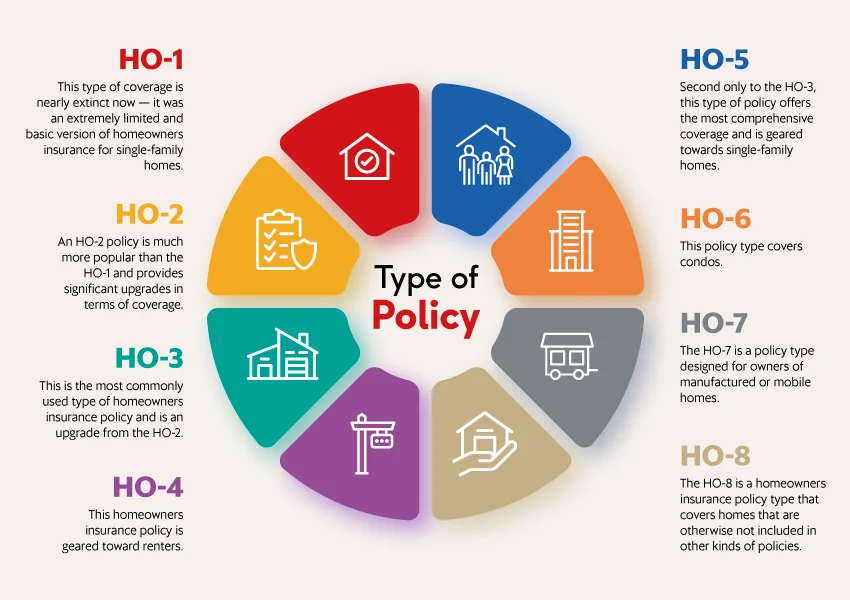
What does homeowners insurance cover in Texas? It depends on the type of policy you get. Based on your specific situation, your agent will recommend a plan from among the eight types of homeowners insurance policies available. Below is a description of what each of these policies covers:
Given the state’s high risk for flooding in some areas, you may want to add a water backup or foundation coverage endorsement, since it might not be included in the standard policies listed above.
What Is the Most Common Homeowners Insurance in Texas?
The most popular policy in this state is the HO-3 because it is relatively well-priced and provides an excellent level of coverage. Policyholders find the other types to be either too costly or to provide too little protection.
Does homeowners insurance cover all natural disasters? Not necessarily. Because Texas is disaster-prone, you may need to purchase separate policies to protect yourself from certain events, depending on where in the state you live.
For example, if you live in Port Arthur on the coast of Sabine Lake, where storm surge is a major concern, you might have to obtain a separate flood policy through the National Flood Insurance Program. If you need property insurance in Brownsville, which has flat terrain and is near where hurricanes make landfall, insurers might not cover these wind events in this city, and you would have to get a hurricane policy through the Texas Windstorm Insurance Association.
Get the Best Homeowners Insurance in Texas Today
At InsureOne, we understand why our agents are here to help you find the home insurance that best fits your needs at the best price. You deserve the best plan for your specific situation. Our expert agents will listen to your needs and budget and research options for you so you can spend time doing things you love. At our one‑stop shop, we will present you with competitive options tailored specifically to you.
Do not be deterred by how much homeowners insurance is in Texas. Reach out to us today by phone at (800) 836‑2240, get a quick quote online, or stop by one of our convenient locations. We will help you compare home insurance quotes in Texas to ensure you get the highest quality coverage available.
FAQs
How Much Does Homeowners Insurance Cost in Texas?
The average policy in Texas is a bit over $4,000. However, you might pay significantly more or less than that, as your rate depends on many factors, including the amount of dwelling coverage you need.
Is Home Insurance Required for Homeowners in Texas?
The state government does not mandate that you obtain a policy, but if you take out a mortgage on your house, your lender will require one. Banks place a lien on your home to ensure that, if you default, they can foreclose and sell it to recover their funds. Therefore, they require you to obtain a policy to protect your home, which is the collateral for their loan.
What Weather Risks in Texas Can Affect My Home Insurance Rates?
Flash floods, hurricanes, tornadoes, and wildfires are common in various parts of the state. While these are not everyday occurrences, they happen often enough that the level of claims they trigger is enough to make Texas an expensive state in which to obtain a policy.
Does Texas Offer Any Discounts or Programs That Can Help Lower Home Insurance Costs?
The state government regulates insurers but does not write policies or offer any discounts. However, private insurers do offer many types of discounts, such as for installing a security system, bundling policies, paying your premiums up front, and many more. These discounts are stackable and can add up to significant savings.